Executive Salary Benchmarking: What Will It Actually Take to Hire the Right Leader?
14 October 2026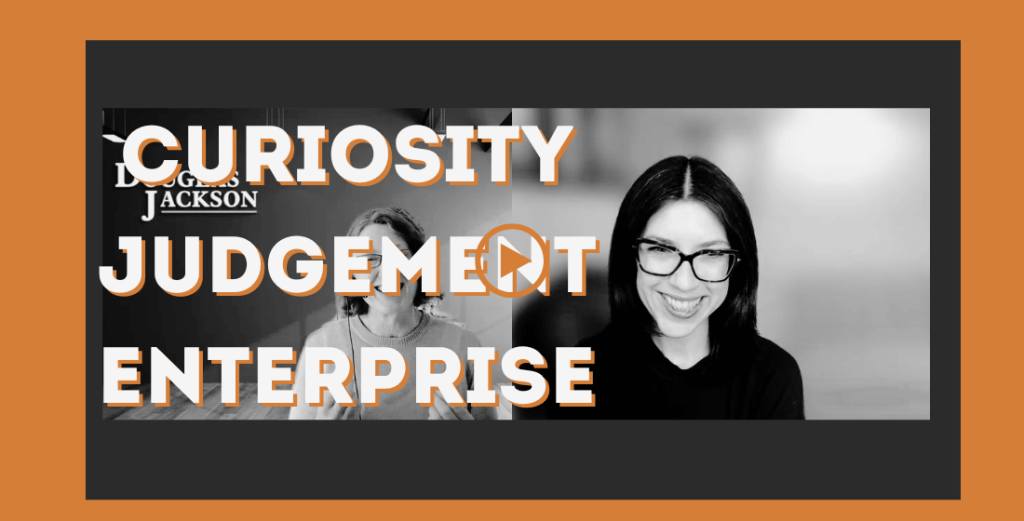
Genevieve Kangurs joins Michelle Ansell in The Impact Room to explore one of the more difficult transitions in a senior leadership career: what happens when the expertise that helped you succeed is no longer enough for the role the organisation now needs you to perform?
At the time of the conversation, Genevieve was Customer Director at Vanquis, with a career spanning customer, product, digital and commercial transformation across Financial Services.
Drawing on that experience, alongside her work with Andy Matheson on Routefinding: Leadership in Uncertain Terrain, Genevieve discusses strategic leadership, curiosity, commercial thinking and why senior leaders sometimes need to let go of the very behaviours that made them successful.
The paradox of progression
Most leaders become senior because they are very good at something.
They build functional expertise, become trusted for their judgement and delivery, and are promoted because of it.
Then the job changes, Genevieve describes promotion not simply as a reward, but as an invitation to lead.
The difficulty is that the next role may require you to rely less heavily on the skills and behaviours that got you there.
When leaders struggle to make that transition, they rarely stop working.
Instead, they often continue doing a more senior version of their previous job — the Sales Director still seeing customers, the Finance Director still diving into spreadsheets, or the functional leader remaining immersed in operational detail.
The challenge is recognising what the organisation now needs that only somebody at your level can provide.
What does being strategic actually mean?
Genevieve challenges the idea that strategy is about having clever ideas or producing impressive presentations.
She describes it instead as sense-making and choice-making.
There are three dimensions:
What is happening?
Look beyond the strategy deck and follow where the organisation actually spends its money, time and attention.
How are we thinking?
Can leaders zoom in and out, connect issues across the enterprise, look forwards and backwards through time and test their assumptions?
What are we going to do?
Diagnosis, choices and coherent action.
That ambiguity is not necessarily something leaders should try to eliminate.
Often the quality of the questions matters more than pretending to have certainty.
The five transitions into enterprise leadership
Genevieve and Andy identify five important shifts leaders need to make as their responsibilities increase:
From functional delivery to strategic contribution
From a functional mindset to an enterprise mindset
From personal expertise to developing others
From responding to change to creating change
From working within the culture to shaping the culture
That final transition is particularly significant.
Senior leaders can underestimate how closely people observe their behaviour. At Executive level, seemingly small actions, decisions and reactions can influence culture far beyond the immediate situation.
What is the work that only you can do?
Senior leaders rarely spend their time on things that are genuinely unimportant.
The problem is that many important things can still be done by somebody else.
Customers need serving. Complaints need resolving. Sales teams need meeting clients. Projects need delivering.
Those things matter, but as responsibility increases, leaders need to identify the work that genuinely requires their particular position, perspective and authority.
Otherwise urgent operational activity can consume the space required for strategic leadership.
Curiosity as a leadership capability
For Genevieve, one of the most valuable habits a senior leader can develop is curiosity.
When somebody holds a different view, her instinct is not simply to decide that they are wrong, but to understand the mental model that led them there.
That matters because senior leaders increasingly operate across organisational boundaries.
Genevieve encourages leaders to get outside their own function and spend time with Finance, Risk, Technology, Operations, Commercial teams, customers and investors.
Different stakeholders may not be wrong, they may simply be looking at the organisation from a different position.
Understand how the organisation creates value
This is particularly important for customer leaders.
Genevieve argues that the role of a customer leader is not simply to advocate for customers.
It is to understand customer needs and solve business problems through the customer lens in a way that creates value for both the customer and the organisation.
That requires understanding:
- How the organisation makes money
- Where value is created
- Proposition economics
- Operational costs
- Risk and regulation
- Capital and investment decisions
- The genuine trade-offs the business needs to make
Customer leadership therefore becomes an enterprise role rather than simply a functional one.
Will tomorrow’s leaders need both breadth and depth?
The conversation also explores how AI may change organisational structures and leadership requirements.
Genevieve questions whether it will remain enough for senior leaders simply to operate horizontally across an organisation.
Her view is that future leaders may increasingly need both:
vertical depth, enough functional expertise to understand the detail and horizontal breadth, the ability to connect decisions across the enterprise.
She uses the analogy of maps; A map detailed enough to guide you along a footpath may not tell you whether you are travelling in the right direction across the country.
Senior leadership requires the ability to move between both perspectives.
Four habits for becoming a more strategic leader
Genevieve suggests four practical disciplines:
Cultivate curiosity.
Ask why people think differently rather than assuming they are wrong.
Get outside your function.
Understand the organisation through the eyes of colleagues, customers, investors and other stakeholders.
Learn the economics.
Understand how the organisation genuinely creates value.
Protect thinking time.
Create enough space to ask questions such as: What am I missing? Whose perspective haven’t I heard? What has changed? What problem are we actually trying to solve?
Leadership in uncertain terrain
Genevieve’s work with Andy Matheson through Routefinding: Leadership in Uncertain Terrain explores the gap between how leadership is described in management theory and how it actually feels inside complex organisations.
Real leadership problems are rarely neat.
They involve ambiguity, competing priorities, organisational politics, incomplete information and different perspectives.
There often isn’t a framework that simply produces the answer.
The challenge is learning how to make sense of the terrain and make better decisions when certainty is unavailable.
What leaders should take away
- Promotion requires more than doing your previous role at a higher level.
- Functional expertise remains valuable, but senior leadership requires an enterprise perspective.
- Strategy is as much about sense-making and choices as it is about plans.
- Senior leaders need to understand how their organisation creates value.
- Curiosity and the ability to work across functional boundaries are increasingly important.
- The best leaders can move between detail and enterprise-level perspective.
- Protecting time to think is part of the job, not time away from it.
- A useful question for every senior leader is: What is the work that only I can do?
About Genevieve Kangurs
Genevieve Kangurs is a senior leader whose career spans Customer, Product, Digital and Commercial transformation across Financial Services.
At the time of this Impact Room conversation, Genevieve was Customer Director at Vanquis.
Alongside her Executive career, Genevieve works with Andy Matheson on Routefinding: Leadership in Uncertain Terrain, exploring how leaders navigate strategy, complexity and organisational life when there are no simple answers.
Building enterprise leadership capability?
Douglas Jackson works with organisations appointing senior leaders across Operations, Customer, Transformation, Strategy, Data and wider Executive leadership.
We help identify leaders who can move beyond functional expertise, work across organisational boundaries and deliver against broader enterprise priorities.
Talk to us about your next senior leadership appointment →