
Genevieve Kangurs: From Functional Expertise to Enterprise Leadership
21 October 2026
Utilities Technology Leadership Is Winning the Hiring Race. But Who Is Landing the Change?
28 October 2026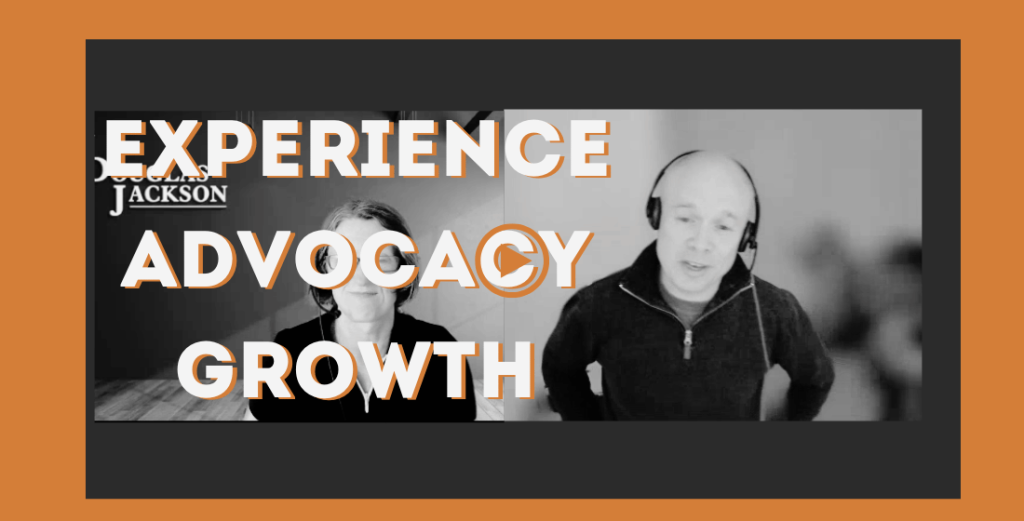
Many organisations say they are customer led, they listen to customers, they measure NPS, they improve journeys and they invest in Customer Experience.
But does that actually make the customer a driver of commercial growth?
In this episode of The Impact Room, Michelle Ansell is joined by James Scutt, a customer-led growth leader whose career has spanned Customer Experience, Transformation, Learning, Community and Advocacy across organisations including Post Office and Qualtrics.
Together they explore why traditional CX can struggle to demonstrate commercial value, why customer advocacy should extend far beyond testimonials and reference calls, and what it takes to turn great customer experiences into retention, advocacy and growth.
Prefer to listen?
Has Customer Experience become disconnected from growth?
Customer Experience teams have spent years demonstrating the link between better experiences, increased loyalty and customers spending more. The difficulty, James argues, is that the commercial impact can be slow and difficult to attribute, sales can point to revenue, Marketing can demonstrate acquisition, Finance speaks directly to the P&L.
CX can sometimes find itself trying to explain how an improvement in experience will eventually translate into commercial value and that creates increasing pressure for Customer teams to connect their work much more directly to organisational growth.
James’s argument is not that Customer Experience matters less. It is that Customer leaders need to become more commercially integrated.
Customer Experience cannot sit in its own language
Different functions naturally focus on the measures against which they are held accountable.
Sales has sales metrics.
Customer Success has retention and expansion metrics.
Operations has performance and efficiency.
Finance has revenue and return.
Customer Experience therefore struggles to gain traction if it arrives with an improvement opportunity that the receiving function cannot connect to its own objectives.
James makes a useful challenge to CX leaders:
Rather than asking other functions to prioritise your Customer Experience goals, understand their goals first and demonstrate how customer insight and experience improvement can help them achieve them.
CX becomes considerably more influential when it stops asking:
“How can you help improve Customer Experience?”
and starts asking:
“How can customer insight help you improve the outcome you are accountable for?”
That is an important distinction.
Are we measuring the wrong things?
The conversation also challenges some of the measures traditionally associated with Customer Experience.
James remains a supporter of NPS when it is used appropriately.
It can provide Boards with a useful benchmark and allow organisations to compare performance over time.
But an NPS score does not necessarily tell an organisation whether its customers are actively generating growth.
The question itself asks whether somebody would recommend a company.
That is different from whether they actually do.
For James, the more interesting question is what happens next.
Does the customer:
- Recommend the organisation?
- Leave a positive review?
- Participate in a customer community?
- Speak at an event?
- Share content?
- Contribute to product development?
- Join an advisory board?
- Provide a reference?
- Expand their relationship?
- Stay longer?
Those actions potentially provide a much clearer bridge between experience and commercial value.
From Customer Experience to Customer-Led Growth
There is a subtle difference between an organisation being influenced by customers and customers actively contributing to its growth.
Improving a journey might make an experience easier.
Reducing friction might improve satisfaction.
Resolving complaints might prevent dissatisfaction.
All are important.
But James asks whether the “led” in customer-led should mean something more.
Is the customer actually helping lead the organisation towards growth?
That means connecting Customer Experience with: retention, advocacy, expansion, community, learning, recommendation and commercial performance.
Without that connection, CX risks remaining one step removed from the priorities occupying the CEO, CFO and wider Executive team.
Customer advocacy is much bigger than testimonials
One of the strongest themes in the conversation is James’s broader definition of customer advocacy.
In many organisations, advocacy still sits largely within Marketing.
It might mean:
A testimonial,
A reference call,
A case study,
Or perhaps an NPS promoter.
James believes that definition is too narrow.
A customer can advocate in many different ways.
They might:
- Post about an organisation on social media
- Recommend it to somebody else
- Leave a review
- Speak at an event
- Join a podcast
- Participate in beta testing
- Help co-create a product
- Contribute to an advisory board
- Become active within a customer community
- Share knowledge internally within their own organisation
These actions are not simply marketing assets, they are evidence of engagement and importantly, they are actions that can often be identified and measured.
Could advocacy help CX demonstrate ROI?
Customer leaders have spent years trying to prove the financial return from Customer Experience.
The difficulty is attribution.
If customer satisfaction rises and revenue subsequently increases, how much of that growth was caused by the experience improvement?
Complex calculations require assumptions.
And once somebody challenges the assumptions, the credibility of the resulting ROI calculation can quickly unravel.
James suggests a different approach.
Bring advocacy into the outcome.
If a customer voluntarily speaks at your conference, recommends your organisation, participates in a community or publicly advocates for your product, there is tangible value in that activity.
Marketing functions have long placed commercial values against comparable activities.
Customer Experience can potentially do the same.
Rather than trying only to prove that an incremental improvement in a satisfaction measure created a particular amount of revenue, CX can begin measuring what customers actually do as a consequence of the relationship.
Get the basics right before chasing the next technology
AI inevitably enters the conversation.
James is positive about its potential within Customer Experience.
But he also warns against becoming distracted by every new technology while basic customer interactions continue to fail.
Organisations already hold significant information about their customers.
Often the opportunity is not particularly futuristic.
It might simply be using existing CRM data intelligently enough to understand what somebody has already bought, what they might need next, or where a more relevant interaction could create additional value.
Technology cannot compensate indefinitely for poor data, broken journeys or weak operational fundamentals.
As James puts it, organisations need to get the basics right and then build the more sophisticated capabilities on top.
Authentic advocacy may become more valuable in an AI world
There is another interesting consequence of AI.
As marketing content becomes easier and cheaper to generate, genuine human advocacy may become more valuable rather than less.
A real customer explaining why they use a product, how it helped them or what they achieved has something AI-generated collateral struggles to replicate authenticity.
James argues that the passion of a genuine customer advocate remains extraordinarily difficult to manufacture.
The organisations willing to invest the effort required to create genuinely good experiences may therefore gain an increasingly valuable asset, customers who are prepared to speak for them.
What should a new Customer leader do in the first 100 days?
For a Chief Customer Officer or senior CX leader joining a new organisation, James recommends resisting the temptation to immediately declare that everything needs rebuilding.
Start by understanding what already exists.
A traditional Customer Experience maturity assessment can still be valuable.
Look at the organisation’s capability.
Understand the levers available.
Assess advocacy as well as experience.
And importantly, find the existing pockets where Customer Experience is already being done exceptionally well.
Those teams and individuals can become advocates for the wider change.
Starting from the assumption that everything is broken risks alienating the people who have already been quietly doing good work.
Most importantly, the connection with commercial performance should not become a secondary workstream.
It needs to be built into the Customer strategy from the beginning.
Customer leaders are change leaders
James also makes an important point about the role of the Customer Experience professional.
They are not simply representatives of the customer.
They are agents of organisational change informed by customer insight.
That means their effectiveness depends upon influencing other functions.
And influence requires speaking the language of the people whose behaviour needs to change.
A Sales Director needs to understand how customer insight affects sales.
An Operations Director needs to understand how it affects operational performance.
A CFO needs to understand its relationship with value.
The same customer message cannot simply be broadcast across every function.
Ironically, Customer leaders need to apply internally exactly the same principle they advocate externally:
understand your audience and make the proposition relevant to them.
Customer Experience and enterprise value
The conversation also touches on a particularly relevant issue for investors and PE-backed organisations.
Customer Experience, retention, advocacy and reputation all influence the quality and sustainability of a business.
They therefore have relevance beyond Customer teams.
For investors, Boards and Executive leaders considering growth and enterprise value, Customer Experience should form part of the wider commercial picture.
Customers who stay, expand, recommend and advocate represent a very different business asset from customers who merely transact.
What leaders should take away
Customer Experience does not need to abandon its focus on customers to become more commercial.
It needs to demonstrate how better customer outcomes contribute to better business outcomes.
That means:
- connecting CX initiatives to the metrics other functions already care about
- using NPS appropriately rather than expecting one number to prove value
- broadening advocacy beyond testimonials and reference calls
- measuring what engaged customers actually do
- linking Customer Experience with retention, growth and commercial performance
- getting fundamental customer data and journeys right before chasing technology
- using authentic customer voices as increasingly valuable assets
- recognising Customer leaders as cross-functional change leaders
- making commercial impact part of the CX strategy from the outset
Perhaps the challenge for Customer leaders is no longer simply:
“How do we improve the customer experience?”
It is:
“How do we turn better customer experiences into measurable customer-led growth?”
About James Scutt
James Scutt is a customer-led growth leader with experience spanning Customer Experience, Transformation, Learning, Community and Advocacy.
His career has included organisations such as Post Office and Qualtrics, and his work increasingly focuses on the relationship between Customer Experience, advocacy and commercial growth.
Building Customer Leadership That Drives Growth?
Douglas Jackson works with organisations appointing senior leaders across Customer, Operations, Transformation, Strategy, Data and wider Executive leadership.
We help clients identify leaders capable of connecting customer outcomes with operational performance, commercial growth and enterprise value.
Talk to us about your next Customer or operational leadership appointment →